



Just Breathe
When we get caught up in the stress of everyday life, it’s important to take a step back, listen to our bodies, and find ways to center ourselves. Deep breathing is a widely used technique recommended by many healthcare professionals and a useful tool when working with a coach.
By practicing deep breathing, we are intentionally changing the rate and depth of our breathing, which can have a variety of positive effects on our physiology. Deep breathing can help with everything from improving our mental and physical health, to building self awareness, to improved decision making.
According to a number of scientific studies, deep breathing exercises have been found to significantly reduce symptoms of anxiety and depression, improve mood, and increase feelings of well-being. One of the primary ways that deep breathing reduces stress is by activating our parasympathetic nervous system, which is responsible for our “rest and digest” response.
The act of taking deep breaths sends a signal to the brain via the vagus nerve that we are in a calm state, which in turn slows down the heart rate and respiratory rate. This relaxation response also reduces the release of stress hormones like cortisol and adrenaline, which are associated with the “fight or flight” response of the sympathetic nervous system. While these hormones can be helpful in the short-term, long-term exposure can lead to a number of health problems.
In addition to increasing anxiety and depression, chronic high levels of cortisol and adrenaline can lead to a weakened immune system, increased blood pressure, increased risk of heart disease, and impaired cognitive function. Prolonged exposure to cortisol can even lead to a decrease in bone density, muscle mass, and an increase in abdominal fat.
Beyond the significant health benefits, deep breathing exercises can also be used as a coaching tool for building self-awareness and mindfulness. We can learn to tune in to our physical and emotional responses, and develop a greater sense of control over our reactions. We can recognize our patterns of behavior, both positive and negative, and how they impact us and those around us. With this understanding, we can make more informed decisions and develop healthier habits that align with our personal and professional goals.
Lastly, deep breathing can help improve our mental clarity and focus, which can be especially important for when making complex decisions and thinking critically in high-pressure situations. By taking a few moments to focus on deep breathing, we can clear our minds and improve our ability to think creatively and strategically.
Give it a Try!
If you want experiment try this simple full-body breathing exercise:
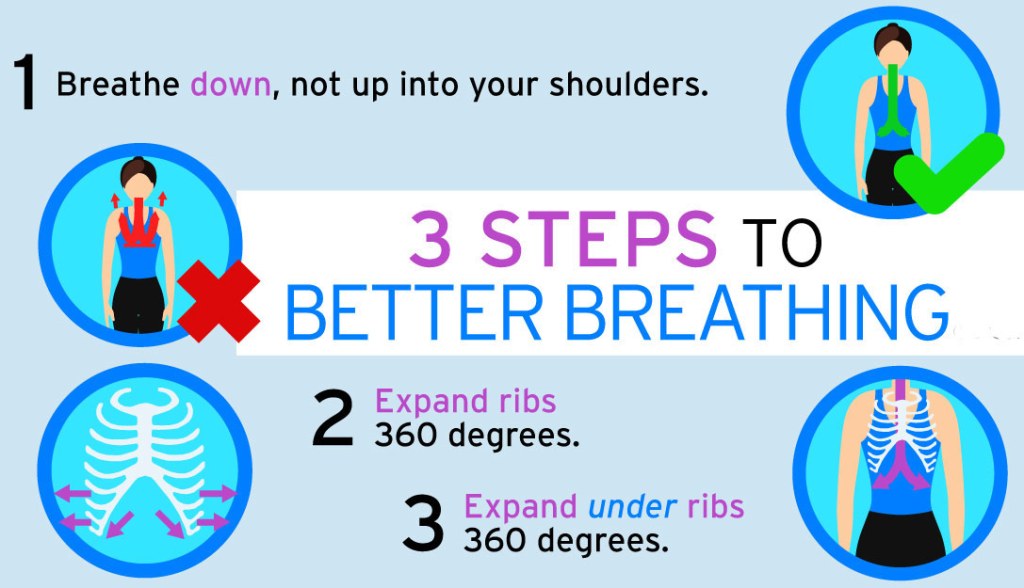
- Either sit comfortably with your feet planted on the ground, or stand with your feet shoulder-width apart.
- Close your eyes and take a deep inhale through your nose, expanding all of your belly, ribs, and upper chest as you fill your lungs with air.
- Hold your breath for a few seconds.
- Exhale slowly through your mouth, pushing all the air out of your lungs and contracting your belly.
- Repeat steps 2-4 for several more breaths, focusing on the sensation of your breath as you inhale and exhale.
- As you continue to breathe deeply, try to slow down your breath and make each inhale and exhale last a bit longer.
During this exercise, you may ask yourself some of the following questions to increase mindfulness:
- What sensations do I experience as I inhale and exhale? What do I feel, smell, taste, hear, and visualize?
- Where can I feel and let go of tension in my body?
- What thoughts are going through my mind?
- What emotions am I experiencing?
- How does my breath change as I intentionally slow it down?
- Can I visualize the air flowing into and out of my body?
- How do I feel physically, emotionally, and mentally after completing this exercise?
There are a number of other popular exercises like pursed lips breathing, square breathing, and 4-7-8 breathing. What works best for you?
 Oceanwave Coaching