


The first model we’ll discuss as part of the nine-part series on coping with complex conflict is the Thomas-Kilmann Conflict Mode Instrument (TKI). The TKI model is a widely used framework for understanding different approaches to handling conflict that was developed by Kenneth W. Thomas and Ralph H. Kilmann based on their research in the field of conflict resolution. The model identifies five conflict-handling modes that individuals may employ in different situations:
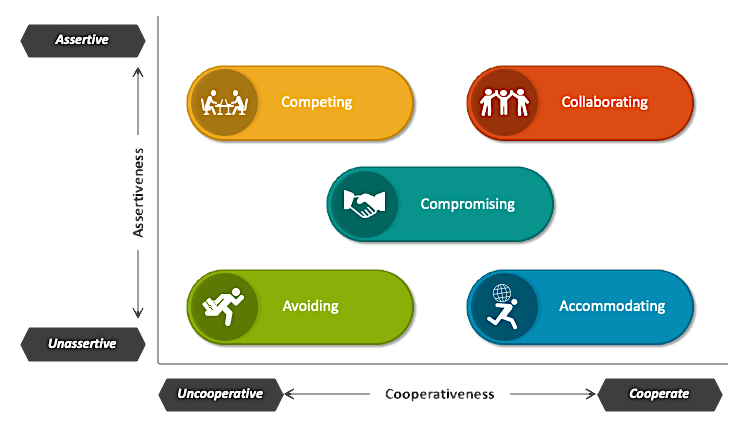
- Competing: This mode reflects a high concern for one’s own needs and goals, often at the expense of others. Individuals who use the competing mode tend to assert their positions forcefully, emphasizing their own viewpoints and advocating for their interests.
- Collaborating: The collaborating mode emphasizes a high concern for both one’s own needs and the needs of others. Individuals who adopt this mode actively seek win-win solutions by collaborating with others, engaging in open communication, and finding mutually beneficial outcomes.
- Compromising: The compromising mode involves a moderate concern for both one’s own needs and the needs of others. Individuals using this mode are willing to make concessions and seek middle-ground solutions that partially satisfy the interests of all parties involved.
- Avoiding: The avoiding mode reflects a low concern for both one’s own needs and the needs of others. Individuals using this mode tend to avoid or withdraw from the conflict, postponing the resolution or simply evading the issue altogether.
- Accommodating: The accommodating mode prioritizes the needs and concerns of others over one’s own. Individuals employing this mode are willing to sacrifice their own interests and yield to the preferences of others in order to maintain harmony and preserve relationships.

The TKI model can be used in various settings, such as personal relationships, teams, organizations, and negotiations. It enables individuals to understand their own and others’ tendencies, and allows them to make more intentional choices in approaching conflicts. Depending on factors such as the nature of the conflict, the relationship between the parties, and the desired outcomes, individuals can choose which mode to exercise or how to flexibly employ multiple modes throughout the process. It’s important to note that there is no inherently “correct” or “best” conflict-handling mode. The appropriateness of each mode depends on the specific circumstances and goals of the conflict. The TKI model
An Example of TKI In Action
Let me share a story about a team of three engineers (we’ll call them Alex, Taylor, and Jordan) who were being coached through a thorny team dynamic. Together, the three of them were responsible for shipping the company’s next big software release, and they were trying to decide which features to keep and which to cut. In addition to new features for existing customers, they were hoping to attract three new market segments. Tensions began to rise the tight deadline loomed near because the features planned for the release only covered the existing customers and one of the three new market segments.
Alex, known for being bold and assertive, took a competing approach to conflict resolution. Most of Alex’s ideas centered around features for one of the new market segments, but completely ignored the other two. Alex strongly advocated for their own ideas and dismissed any input from Jordan and Taylor. This obviously created friction within the team since two thirds of them felt their perspectives were not being valued.
Jordan, on the other hand was extremely introverted and had a tendency to avoid all conflict. Instead of advocating for their own ideas, they preferred to keep quiet and just comply with Alex’s decisions in order to maintain harmony. However, this resulted in Jordan feeling frustrated and resentful of Alex’s steamrolling.
Taylor was known for finding new and creative approaches when challenges arose, and recognized the importance of finding a win-win solution. They knew that things couldn’t go on like they had been, and the team’s best hope was to have an open, honest conversation where a variety of unconventional ideas and opinions were put on the table.
After some coaching, Taylor scheduled a video call with Alex and Jordan to address the elephant in the room and find a resolution that would satisfy everyone’s needs. During the discussion, Taylor stepped into the role of mediator and, by employing active listening and empathy, was able to create a safe space for constructive communication. First, the team discussed their different approaches to conflict and what they were hoping to get out of the discussion. They found common ground around shipping a product that would wow their users and open up those new markets for the business.
Taylor encouraged Alex to consider alternative ideas while also asking Jordan to share their opinions. Alex agreed to keep an open mind and asked Jordan to speak first. Somewhat reluctantly, Jordan described an idea that would enable them to release three more minimally-scoped features than they originally thought possible, targeting the second untapped market and adding mock-ups of functionality that would appeal to the third. When Alex enthusiastically supported this idea, Jordan recognized that avoiding the conversation had been hindering the team’s progress and growth. Alex, on the other hand, realized that fighting solely for their own ideas was overshadowing valuable contributions that were better for the business as a whole.
Had the team done nothing, they would have put out a release that met fewer of their user’s needs and completely missed delivering to those other two market segments. Instead, they had a monumentally successful release that also opened a floodgate of new customers in that third market segment after they saw the mock-ups.
꧁༺ ༻꧂
This is just one example of how you might apply the TKI model, but you can adapt it to the specific context and needs of the situation you’re in. Avoiding the conflict might be the right answer if, for example, you’re not invested in the outcome or the relationship because the other person is operating in bad faith. Or maybe you choose to accommodate the CEO who asks you to work during your vacation because you know they don’t request hero work like that often, and it’s really important for the business right now. Use the model to decide the best approach based on the outcomes you want.
 Oceanwave Coaching