


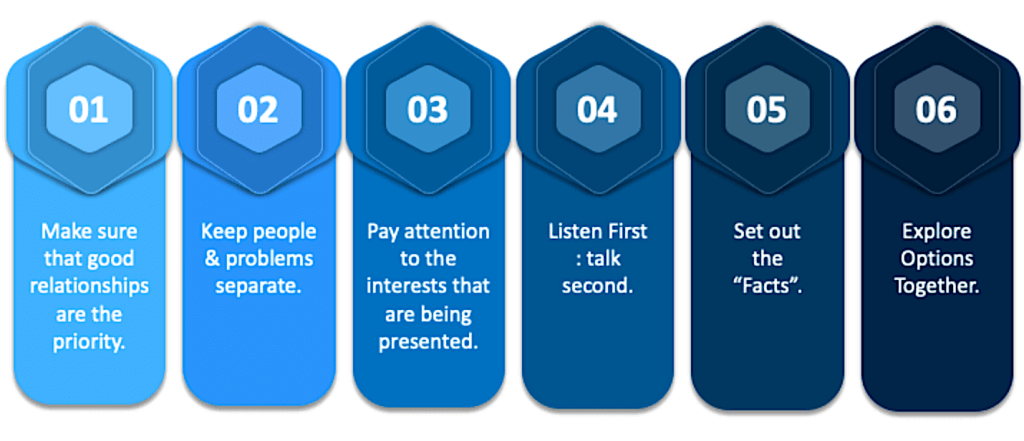
The Principled Negotiation framework, described by Roger Fisher and William Ury in their book, “Getting to Yes,” encourages cooperative problem solving by separating the people and their emotions from the challenge. It centers around the belief that, when individuals recognize and leverage common goals and shared values instead of focusing on their differences, they strengthen their relationship and pave the way for effective collaboration. The Interest-Based Relational (IBR) Approach or Interest-Based Bargaining (IBB) are applications of the Principled Negotiation framework.
How to Use the IBR Approach
The model is broken up into six key steps:
- Make sure that good relationships are a priority. Treat the other people in the discussion with respect. Do your best to be courteous, and to discuss matters constructively.
- Separate people from problems. Recognize that, in many cases, the other people are not choosing to be maliciously obstructive. Valid differences can lie behind conflicting positions. By separating the problem from the person, you can discuss issues without damaging relationships.
- Listen carefully to different interests. You’ll get a better understanding of why people have adopted their position when you try to see things from their point of view.
- Listen first, talk second. Listen to what the other people are saying before defending your own position. They might say something that changes your mind.
- Set out the “facts.” Together, decide on the observable facts (not opinions or inferences!) that might impact your decision.
- Explore options together. Be open to the idea that you might jointly reach another, as yet discovered, position or solution.
During the process, focus on behaving courteously and insist that others do the same. The priority is to help all sides develop an understanding of other’s positions, and to encourage reaching a consensus – even if that means agreeing to disagree.

An Example of the IBR Approach in Action
Remember our friends Alex and Jordan from the previous articles in this series? They were still vying for a limited budget to support their respective initiatives for developing new product features and had now escalated it to their manager, Ashley.
Step 1: Make Sure Good Relationships Are a Priority
Ashley decided to facilitate a face-to-face meeting with Alex and Jordan to clarify the importance of good relationships and to identify the main problems. As the manager, their priority was to ensure that everyone understood how the conflict was a mutual problem, and that it was important to resolve it through respectful discussion and negotiation rather than aggression. They made it clear that it was essential for everyone to be able to work together happily, effectively and without resentment, so that the team and organization could function effectively. Ashley started by expressing respect for both their points of view and appreciation for their desire to resolve the situation in a professional manner.
Step 2: Separate People From Problems
Ashley pointed out that conflict was rarely one-sided, and that it was best to resolve it collaboratively, by addressing the problem rather than the personalities involved. The problem wasn’t caused by either person, but they needed to work together to resolve it.
Alex started out by claiming that Jordan was being defensive and demanding, while Jordan claimed that Alex was ignoring everyone else’s interests. Ashley again pointed out that that was focusing on the person instead of the problem. The problem was whether the organization could afford to invest in development of both new sets of features.
Step 3: Listen Carefully to Different Interests
Ashley asked both Alex and Jordan for their viewpoints, and reconfirmed that cooperation was needed from both of them to solve the problem. Ashley also asked them to make an effort to understand one another’s motivations and goals, and to think about how those may affect their actions.
Suggesting that they keep the conversation courteous, and avoid blaming anyone, Jordan encouraged everyone to use active listening skills, such as looking directly at the speaker, listening carefully, nodding, and allowing each person to finish before talking. They knew that by focusing on listening, it would help prevent the conversation from becoming heated and getting out of hand.
Step 4: Listen First, Talk Second
When Alex started to interrupt Jordan with their own idea, Ashley reiterated that each team member first needed to listen to the other’s point of view, without defending their own position. Ashley asked Alex to wait until Jordan was finished talking, emphasizing that the first goal was understanding the problem fully and only asking questions to obtain clarification.
Together, they all decided to create some ground rules before continuing the discussion:
- Listen with empathy, and to see the conflict from each other’s point of view.
- Explain issues clearly and concisely.
- Use “I” rather than “you” statements, so that no one felt attacked.
- Be clear about their reasoning and feelings.
- Remain flexible and adaptable.
Once Jordan and Alex’s views had both been heard, they were more receptive to different perspectives. Jordan didn’t realize that Alex had been working with the Sales team in order to help them close a deal on a hot new prospect who would go to a competitor without a specific new feature. Alex didn’t realize that Jordan had also been talking to Sales about how to keep a group of existing customers from cancelling their contracts because of key functionality missing from the product.
Step 5: Set Out the “Facts”
Alex and Jordan were trying to solve two different problems, obtaining new customers and preventing existing customers from leaving. As the three of them talked, they agreed that the problems they really needed to address were how to grow the company’s revenue and what that meant for their product roadmap. The facts were that focusing on one feature or the other would mean they’d lose out on potential revenue from at least one source. They needed more info about how much revenue and the lost opportunity cost.
Step 6: Explore Options Together
At this point, Jordan and Alex understood the other’s position better, and could get down to the work of solving the overarching problem they were both facing. They still had differing opinions on what the best solution was, so they decided to invite representatives from the Product team and the Sales team to get some more data.
The sales team was excited by the idea of expanding the market and landing this hot new prospect with Alex’s feature, but they also knew it would be catastrophic if they didn’t release Jordan’s feature, since the expectation was that they would lose 20% of their revenue in cancellations. The new customer would only bring in 5% more revenue, though there were other potential prospects who were interested in the same feature.
As everyone brainstormed how to solve the revenue problem, one of the Product people laughed and suggested that they have the hot new prospect pay for the feature up front, which would allow the company to fund the development by hiring another engineer. The two Sales representatives looked at each other, and one said “Actually, they want this feature enough that that just might work. They may not pay for the whole thing up front, but they might be willing to sign at a reduced rate contract up front if we can commit to a timeline.” Alex leapt at this idea, saying “That might get us enough money to hire a contractor so we can focus on both features now. Then once Jordan’s feature is done, we can switch focus and finish up mine. I think that would only extend the delivery time by about 25%, which might be acceptable to the prospect!”
Ashley was pretty happy with the outcome. Once Alex and Jordan stopped the finger pointing and were able to recognize the real issue they were trying to solve, everyone pitched their wild ideas until they found one that might even be able to meet both needs. Sales would need to verify that with the customer, but it was better than what they had at the beginning of the conversation.
꧁༺ ༻꧂
The Interest-Based Relational (IBR) model offers a transformative approach to building productive relationships in the workplace. By harnessing shared interests, embracing diversity, fostering empathy, and creating an inclusive environment, this model enables teams to unlock their full potential and achieve positive outcomes. You can blend it with other models that help identify the overarching problems like the Circle of Conflict and models that help each participant understand each other’s default conflict resolution styles like the TKI model (both discussed in prior articles).
 Oceanwave Coaching
One response to “Constructive Conflict Framework #5: The Principled Negotiation / IBR Model”
[…] The Principled Negotiation or Interest-Based Relational Approach (IBR) framework that views conflict through the lens of integrative bargaining and prioritizes relationship management. […]
LikeLike