


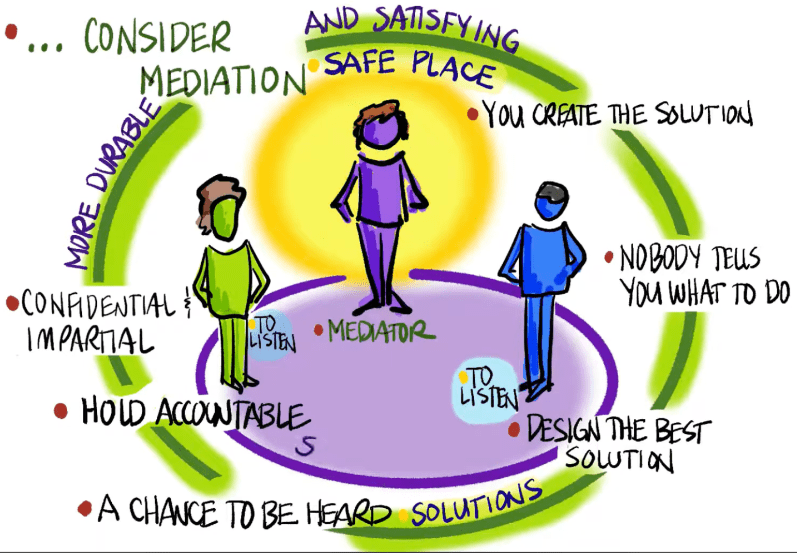
In their book “The Promise of Mediation: The Transformative Approach to Conflict,” Robert A. Baruch Bush and Joseph P. Folger describe the model of Transformative Mediation, a catalyst to empower individuals and enhance relationships while resolving disputes. They recognized that traditional mediation models focused primarily on reaching settlements or agreements, often overlooking the deeper dynamics of conflict and the potential for personal growth and relational transformation.
Key Principles of Transformative Mediation
Bush and Folger’s Transformative Mediation model revolves around the two concepts of empowerment and recognition. Mediators create a safe and supportive environment by fostering active listening, empathy, and understanding, allowing parties to gain insight into their own and the other person’s perspectives.
Empowerment is viewed through the lens of goals, options, skills, resources, and decision making:
- Goals – each party understands the importance of their goals and interests.
- Options – the parties understand the range of options available to them and realize that control over the choices is theirs alone.
- Skills – each party employs their skills in conflict resolution including: listening, communication, organizing and analyzing issues, presenting arguments, and brainstorming solutions.
- Resources – each party understands the resources they already posses. obtains more if necessary, and learns how to use them more effectively.
- Decision making – each party uses good decision-making skills to evaluate the settlement options and decide how (or whether) to settle the conflict.
Recognition can be granted to the other party through thoughts, words, or actions, but doesn’t necessarily mean reconciliation. Bush and Folger see value in merely being able to acknowledge other’s ideas and opinions without having to agree with them.
- Thoughts – seeing things from the other party’s perspective instead of one’s own.
- Words – openly acknowledging and expressing understanding of the other party’s perspective.
- Actions – changing one’s own conduct to accommodate the other party.
In the Transformational Mediation model, the mediator first helps the parties set some ground rules and then focuses on three different patterns to help the parties augment self-awareness, self-determination, and relationship-building via empowerment and recognition:
- Focusing on parties individual contributions to the dialogue instead of labeling the conflict as being a particular type.
- Encouraging parties to deliberate and make choices amongst themselves instead of dictating solutions to them.
- Framing arguments in an effort to lead the parties to recognize each other instead of ignoring relational/interpersonal issues.

An Example of the Transformative Mediation Model In Action
The two software engineers from the previous articles in this series, Alex and Jordan, have one more hurdle to clear before they’re ready to release a major new version of their product. They need to help create the customer documentation and help write materials to train the sales team, but both of them want to start on new projects instead. They asked their co-worker, Taylor to help mediate the discussion, since they couldn’t reach an agreement on their own.
Taylor starts by stating the reason for the meeting and having Alex and Jordan set some ground rules, “Thank you to you both for agreeing to meet today. I understand that you have concerns regarding writing the documentation for the new software release and the training responsibilities for the sales team. This mediation session is an opportunity for us to address those concerns and find a resolution that works for everyone. Before we delve into the discussion, let’s establish some ground rules that will guide our conversation and create a respectful and productive environment. What do each of you need to create a safe, constructive space?”
Alex and Jordan think about their previous discussion and when things went well, and when the conversation went off the rails. Between the two of them, they come up with the following list:
- We’ll maintain a respectful atmosphere where everyone has the opportunity to be heard and express their thoughts and feelings. We’ll give our full attention to the person speaking.
- As part of that, we won’t interrupt each other, instead waiting the other person is done speaking before sharing our own thoughts.
- When expressing our thoughts and concerns, we’ll try to use “I” statements to own our perspectives rather than making assumptions about each other or anyone not in the room with us.
- We’ll try to focus on the underlying interests and needs of each party and think in terms of collaborate solutions instead of just our own wants and needs.
- Everything discussed during this mediation session will be treated with strict confidentiality. This ensures that we both feel comfortable sharing our perspectives openly and honestly.
- If anyone feels overwhelmed or needs a break, we can request a brief break to calm down and refocus on the outcomes we want.
And with that, Alex started the conversation with a deep sigh. “We’ve been working on this release forever, and I feel overwhelmed with my current workload. Taking on additional responsibilities for documenting the software release and training the sales team is causing me a lot of stress. I just want to drop some of this cognitive load and focus on something new and energizing.”
Jordan was fidgeting, but managed to wait until Alex was done talking before speaking up. “Me, too, and I don’t feel comfortable being responsible for aspects that aren’t really playing to my strengths.”
Taylor wanted to acknowledge what both Alex and Jordan were feeling, and get them to acknowledge each other. “I hear both of you expressing your concerns and feeling overwhelmed with the added responsibilities and wanted to recognize the feelings behind that. Jordan, can you tell us a bit more about what you mean about playing to your strengths?”
“I’m not really great at writing documentation, and even worse at trying to teach people in a live session,” Jordan said unhappily. “I get really nervous, and fumble over what I want to say. Everyone comes out of the training session more confused than when they went in. This release is a big deal, and I want our sales team to feel confident when they’re pitching it to potential customers.”
“Oh, I hadn’t really thought of it like that,” said Alex with a bit of resignation. “You’ve said you don’t like giving talks, but I hadn’t considered what that meant for training. I’m just feeling so burnt out, though, that I don’t think I’d do a great job at the training, either, even though I actually like talking in front of people.”
“Alex, can you say a bit more about feeling overwhelmed and wanting to start a new project,” Taylor asked. “Those things sound like they might be in conflict.”
“I do feel exhausted and overloaded. I know it seems counterintuitive,” smiled Alex, “but closing out one project and starting something new gives me more energy.”
“What’s your mutual goal in this?” asked Jordan, looking at both of them in turn.
Taylor and Alex managed to talk over each other: “Happy customers, and a week of sleep!” “Supporting our colleagues, and avoiding public speaking!”
“Sorry, I didn’t meant to talk over you, Taylor. I also want to support our sales team; I think that’s part of what will give us happy customers.”
“Yeah, sorry, Alex, got carried away. And I appreciate you thinking of the bigger picture there, too. Ditto, I want what you want. I just don’t see a great way of getting there.”
Wanting to make sure that they felt empowered, Taylor asked, “What are some possible solutions? They don’t have to be great ones at this point, just all ideas on the table.”
After writing a dozen different ideas down, Alex and Jordan looked over the list they’d come up with. “Hm, Alex, is your biggest issue feeling exhausted at this point, or is it wanting to start on new projects,” asked Jordan. “It’s definitely feeling wiped out. Closing out all the open ideas in my head and starting a new project is just the way I cope with that.”
“What if,” Jordan said slowly, “you took a week of vacation while I worked on the first draft of the documentation? And then you could review what I’d done, make corrections, and deliver the training. Would that give you time to recover?”
Alex looked thoughtful, “Actually, that might work. Do we have enough time for that?” Jordan did a bit of mental math. “If there aren’t that many changes to make and we could do the training the week you came back, I think that would work. I’m betting I can enlist someone else’s help for some feedback while your out of the office.”
Taylor looked back and forth between Jordan and Alex, both of whom seemed to have perked up at the thought of a workable solution that decreased some of their stress. “It sounds like you’ve worked out a potential plan! I encourage you to keep collaborating to hammer out the details so that you stay on the same page.”
Jordan nodded and said, “Thanks for helping us set those ground rules and for listening without judgement, Taylor. I was really so anxious about the public speaking thing I couldn’t think of any clever ideas, just trying to avoid doing the training.”
“Yeah, thanks, Taylor, it was great to have a neutral third party to just listen and acknowledge that we’re in a tough situation. It lifted some weight off my shoulders just to know I was being heard,” said Alex.
꧁༺ ༻꧂
Transformative Mediation offers a paradigm shift in conflict resolution, emphasizing personal and interpersonal growth as the primary objective. By empowering individuals, promoting recognition, and facilitating transformation, it unlocks the potential for lasting change and constructive relationships in the following ways:
- Enhanced Self-Awareness: Individuals gain a deeper understanding of their own values, needs, and triggers. This increased self-awareness enables personal growth, leading to improved self-confidence, emotional intelligence, and interpersonal skills.
- Strengthened Relationships: The process helps build trust and strengthen relationships fostering empathy, active listening, and recognition of each party’s experience. It promotes open and honest communication, paving the way for more authentic connections and long-term collaboration.
- Sustainable Solutions: By focusing on underlying interests and needs, rather than positions, it increases the likelihood of sustainable and durable agreements that address the root causes of conflict.
- Organizational Impact: Organizations that embrace transformative mediation as a conflict resolution strategy often experience increased productivity, reduced turnover, and a positive work environment.
꧁༺ A Happy Ending ༻꧂
Alex took his vacation while Jordan did a first draft of the documentation and the accompanying training for the sales team. Jordan enlisted the help of Sam, another engineer at the company who worked on the last release to help provide some feedback and do some copy editing. When Alex returned from vacation, feeling quite a bit less crispy around the edges, the two of them did a walk through of everything and Alex made some final modifications. As promised, Alex delivered the training to a grateful sales team, and the company released the new major version of the product just one day after the internal deadline.
At the release party, Alex and Jordan raised a glass to each other to celebrate months of hard work, collaboration, and personal growth. The new product release was a shining success, and each of them moved onto other projects. Though they weren’t working together on the next release, they knew that when they wound up on a project together again, they would have much better tools to working through conflict and tough conversations.
 Oceanwave Coaching
One response to “Constructive Conflict Framework #8: The Transformative Mediation Model”
[…] The Transformative Mediation model, which focuses on using a third party to change interpersonal dynamics. […]
LikeLike