


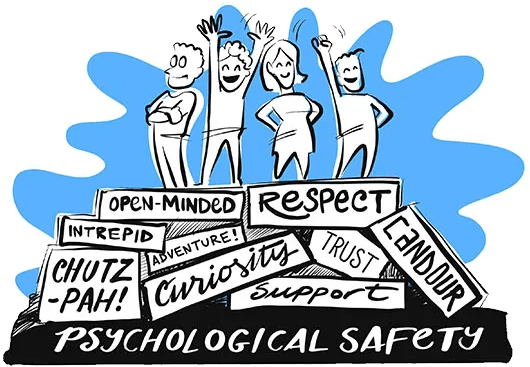
The concept of psychological safety was popularized by the Harvard Business School professor, Amy Edmondson, in the early 2000s through her research and books on team dynamics and learning organizations. The term refers to a shared belief within a group or organization that individuals can express themselves, take risks, share their ideas, and be their authentic selves without fear of negative consequences, embarrassment, or punishment.
Psychological safety is not just about being “nice” or avoiding conflict. On the contrary, it’s about creating an atmosphere where open communication and constructive feedback are encouraged, even when ideas or opinions may challenge the status quo. In such an environment, people feel free to admit mistakes, seek help, and ask questions without worrying about being judged or undermined. Edmondson found that teams with this sense of safety were more likely to experiment, share knowledge, and learn from failures, which ultimately led to improved performance and outcomes.
Building on that work, Tim Clark later published the book The 4 Stages of Psychological Safety in which he posited that there were four distinct stages that individuals sequentially went through on their journey to becoming innovative group/team/organization contributors. Throughout his book, Clark also emphasizes the crucial role of leadership in creating and sustaining psychological safety. To create high-performing teams, they must model vulnerability, encourage open communication, and provide support for their teams.
Let’s explore the four different stages and how leaders and team members can foster psychological safety during each one.

Stage One: Inclusion Safety
The foundation of psychological safety lies in the Inclusion stage. At this stage, teams and organizations focus on building an inclusive culture that embraces diversity and empowers all employees to participate fully. Teams in the Inclusion stage actively seek out diverse viewpoints, encourage empathy, and ensure that everyone’s voice is heard. Individuals on the team don’t merely tolerate each other, but proactively seek to make each other feel geinuinely welcomed and valued for their contributions.
A few things leaders can do to foster Inclusion Safety:
- Reflect on their own leadership style and how their biases show up in interactions with team members.
- Recognize and celebrate different backgorunds perspectives to reinforce the value of inclusivity.
- Encourage the team to create norms for how they will equitably meet each others needs when they work together.
- Create social engagement opportunities where each team member gets to know the others as individuals and foster trusting relationships.
- Create opportunities for cross-functional collaboration to break down silos and encourage diverse interactions.
- Avoid blaming, divisive talk, and gossping within the team, including about people outside of the team.
Stage Two: Learner Safety
In the Learner stage, the focus shifts from an individual just passively feeling like they belong on the team to actively cultivating a learning-oriented mindset. Teams and organizations at this stage encourage people to experiment, learn from failures, and continuously improve. Mistakes are seen as opportunities for growth, and employees are supported in taking calculated risks without fear of repercussions.
A few things leaders can do to foster Learner Safety:
- Demonstrate vulnerability by openly admitting their mistakes, modeling how to handle failure, sharing personal challenges, and being transparent about their own learning and growth journeys.
- Establish regular feedback loops that acknowledge and reward employees who take calculated risks, experiment with new ideas, and learn from both successes and failures.
- Encourage a growth mindset by praising effort and resilience and emphasizing that abilities and intelligence can be developed through learning and practice.
- Provide resources for ongoing learning and development to encourage skill-building and knowledge acquisition.
- Establish forums or meetings where team members can openly discuss what they have learned, share insights, and seek input from others.
Stage Three: Contributor Safety
In the Contributor stage, employees are empowered to actively contribute their ideas and expertise to the team and organization. They feel confident that their opinions are valued and that their contributions make a difference. This stage emphasizes a collaborative environment where teamwork thrives and creativity flourishes.
A few things leaders can do to foster Contributor Safety:
- Set clear expectations for contributions and involvement within the team that ensure that everyone understands their role and the impact they can have on team success.
- Encourage bottom-up idea generation and empower employees to take ownership of their projects.
- Recognize and reward not only individual achievement, but also where cooperation and teamwork lead to better outcomes for the whole team/organization.
- Emphasize the importance of diverse perspectives in innovative problem-solving and decision-making, and encourage team members to bring their unique viewpoints to the table.
- Establish platforms for sharing ideas and feedback, ensuring that employees have a voice in decision-making processes.
- Recognize and reward innovative contributions, reinforcing the value of active participation.
Stage Four: Challenger Safety
The Challenger stage represents the pinnacle of psychological safety, where individuals are not only comfortable contributing but also feel confident challenging the status quo. In this stage, people are encouraged to question prevailing assumptions and suggest alternative approaches. This culture of constructive and creative dissent enables organizations to stay agile and adaptable.
A few things leaders can do to foster Challenger Safety:
- Emphasize the importance of critical thinking and encourage employees to question existing practices from a first principles perspective.
- Foster a culture where decisions are based on objective information rather than personal opinions by encouraging team members to support their challenges and proposals with relevant data and evidence.
- Create team channels for respectful, constructive dissent, where individuals can challenge ideas without fear of reprisal.
- Foster a mindset of continuous improvement and reinforce the value of learning from each iteration.
- Celebrate instances where challenges led to positive outcomes, reinforcing the value of open dialogue.
- Acknowledge power differentials and establish a feedback system where team members can provide candid, anonymous feedback to leadership.
Measuring Psychological Safety

Ironically, measuring psychological safety, in and of itself, requires the participants to have some degree of psychological safety. Even if you make the surveys completely anonymous, individuals who feel very little safety may not answer truthfully, possibly in ways designed to intentionally skew the results. Therefore, while it can be helpful to take the temperature of the team, you should also allow for the fact that the reported results may be roiser than reality.
When designing an anonymous questionaire to measure something of this nature, I find it helpful to phrase the questions as statements that use a Likert scale of 1-4, where 1 Is Strongly Disagree, and 4 is Strongly Agree. I recommend leaving out the ambigious possibility of being right in the middle of a 5-point scale, since that can often encourage people to select it when they mean “I don’t know” as well as “sometimes.” If you want to leave space for “I don’t know,” make that an explicit option.
Here are some sample questions, which intentionally use a mix of positive and negative framing, that you could randomize to collect feedback from individuals about their feelings of psychological safety. It’s also helpful to add a comment section along with each question so that people can clarify or give concrete examples as desired.
- I don’t feel comfortable taking risks and trying new ideas.
- My opinions and ideas are valued and respected by my colleagues.
- I speak up and share my concerns without fear of negative consequences.
- I feel left out of conversations where I believe my opinion would be valuable.
- Mistakes are treated as opportunities for learning and improvement.
- I can be my authentic self without fear of judgment or discrimination.
- Disagreements and diverse opinions are welcomed and encouraged within the team.
- I can challenge the status quo and propose alternative approaches without hesitation.
- My team will ignore me or react negatively if I raise concerns or report issues.
- I am supported in my professional development and pursuit of new skills or knowledge.
- People speak negatively about others at the company.
- I am blamed by others when I make mistakes.
- I ask for help and seek guidance from my colleagues when I need it.
- I worry about asking for help and seeking guidance from my team leader when I need it.
- My team fosters an inclusive environment that values diversity and embraces different perspectives.
- I am not likely to share my ideas and suggestions with my team
- My team takes my feedback into account and acts upon it.
- I don’t feel heard or understood when I express my thoughts or concerns.
- I am encouraged to take ownership of my work and contribute to the decision-making process.
- I don’t feel like I fit in with the team.
It’s important to do something with the data once you collect it. There’s nothing more demoralizing than being asked your opinion on things and then feel like your feedback is ignored. Discuss the results with the team and develop a plan to address areas where they want to see improvement. This helps:
- Educate people about what psychological safety is
- Surface issues that are impacting psychological safety
- Make psychological safety safe to talk about
- Encourage the very behaviours that increase psychological safety
Use the same survey on a regular basis to see whether things are improving, staying the same, or getting worse. Once a quarter or every six months is a good interval that gives changes time to take effect without waiting so long that the team forgets or thinks the feedback isn’t being followed up on.
꧁༺ ༻꧂
Building a culture of psychological safety is a journey that teams must undertake to unlock their full potential. The four stages of Inclusion, Learner, Contributor, and Challenger Safety represent stepping stones towards creating an environment where employees feel valued, engaged, and empowered. As you invest in fostering psychological safety, you will create a team that thrives on innovation, collaboration, and continuous improvement, empowering their success.
 Oceanwave Coaching