


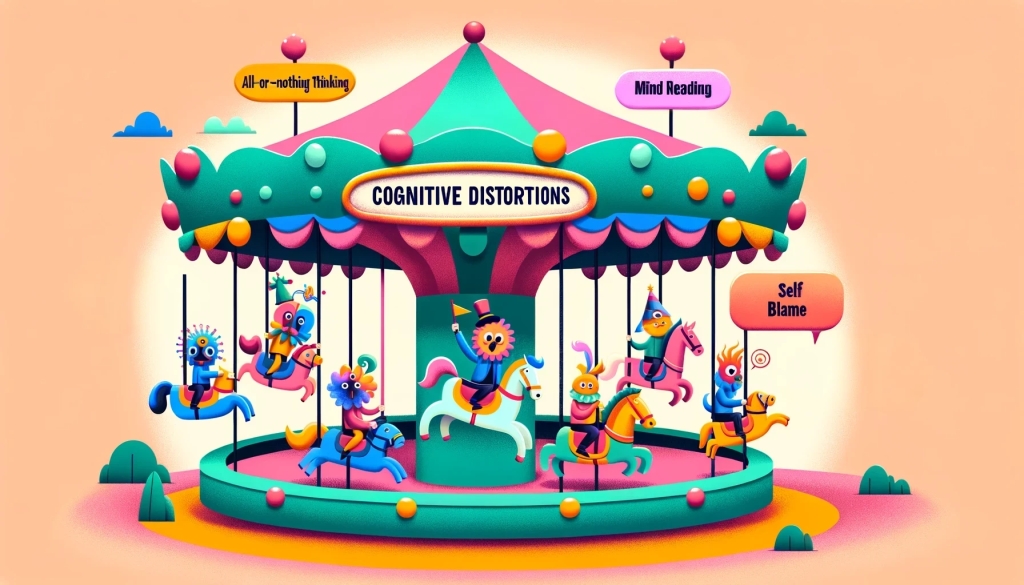
Remember the last time you found yourself stuck in a loop of negative thoughts that you couldn’t seem to break free from, no matter how hard you tried? It’s like a mental merry-go-round that keeps you from moving forward. Identifying and changing these unhelpful thinking styles is essential for maintaining mental clarity and emotional health, particularly in leadership roles. But how do you recognize these negative thought patterns, and what can you do to get back on track?
Your Frenemy, Cognitive Distortion
Your brain is always a few moves ahead, often railroading you into old patterns that no longer serve you well. This well-documented phenomenon was first explained by pioneering psychiatrist Aaron Beck. He introduced us to ‘schemas’—ingrained mental habits—and identified what he called ‘cognitive distortions’ as the usual suspects behind many of our thinking mishaps. Let’s start by unpacking each of the common cognitive distortions, many of which are closely related and play off of each other:
- All-or-Nothing Thinking: Seeing things in black and white, like “If I’m not perfect, then I’m a failure.”
- Arbitrary Inference: Jumping to conclusions without evidence, like seeing someone leave early thinking they’re a poor performer.
- Catastrophizing: Expecting the worst, like not getting any feedback on your presentation and assuming everyone hated it.
- Disqualifying Others: Ignoring the validity of others’ opinions by assuming they don’t mean what they say, like disbelieving people who give you positive feedback.
- Disqualifying the Positive: Overlooking the good parts of ourselves or our experiences, focusing only on the negative, like an inspirational leader who believes they aren’t because they have poor time management skills.
- Emotional Reasoning: Trusting our feelings over facts. If you feel worried, you believe we something MUST be wrong.
- Externalizing: Avoiding personal responsibility by blaming others for your problems, like blaming a coworker for not following the meeting agenda when your never shared it.
- Fortune Telling: Predicting the worst without considering other, more likely outcomes, like thinking the organization will fail during economic downturns rather than finding places to cut costs.
- Hindsight Bias: Believing you knew the outcome of an event all along after it has happened, like attributing the success of a project to your foresight about a turn in the market that surprised everyone.
- Jumping to Conclusions: Making quick judgments without the facts to back them up.
- Labeling: Assigning a permanent label to ourselves or others based on limited information, “They’re just bad at problem solving.”
- Magnification and Minimization: Exaggerating negatives and understating positives, whether about ourselves or situations, like spending the majority of your time thinking about low impact, unlikely outcomes instead of large, likely benefits.
- Mental Filter: Focusing on a single detail, often negative, while ignoring the broader context, like fixating on how someone dresses instead of their skill.
- Mind Reading: Assuming we know what others are thinking without their input.
- Overgeneralization: Making broad interpretations from a single event, like thinking all products will be successful because the last two were.
- Permissive Thinking: Justifying harmful behaviors by our feelings, like making excuses for someone’s poor performance because you believe they’re a nice person.
- Personalizing: Believing that what others do or say is some direct response to us, like thinking someone’s frustrated expression is due to what you said instead of their children making noise in the background.
- Self-Blame: Holding yourself unnecessarily responsible for negative outcomes when there are many factors that go into both success and failure.
- Should Statements: Having a rigid view of how things ought to be, which can set us up for disappointment. You should have the same values as I do.
- Social Comparison: Measuring ourselves against others and feeling shortchanged, as with status, posessions, opportunities, etc.
- Thought-Action Fusion: Believing that merely thinking something can make it happen, such as thinkg “If I think the project will be late, that means we’ll definitely miss the deadline.”
John Teasdale and Philip Barnard, known for their work in cognitive neuroscience and for developing the Interacting Cognitive Subsystems (ICS) model, took this cognitive distortion model a step further. Their ICS model explains how negative thoughts create a self-sustaining cycle, especially when we’re already down, reinforcing themselves and deepening our gloom.
Combine that with psychologist Paul Gilbert’s theory that suggests that some of our mental shortcuts, like jumping to conclusions, developed as quick survival tactics. Now you have a lovely self-perpetuating cycle of negative thoughts triggered by your survival instincts. But when you’re trying to decipher someone’s offhand comment in a meeting, not running away from a hungry tiger, these patters cause unnecessary stress and get in your way instead of helping you survive.
Clearing Up the Distortion
Beck’s recommended solution to dealing with these distortions was to question their validity and actively consider less pessimistic alternatives. But what does that look like in practice? It’s helpful if you partner with someone like a coach or a therapist who provides external perspective, but you can also try using deep introspection to work through the following exercises:
Identification: Start by cataloging the common cognitive distortions that show up in your daily life. Imagine each distortion as a quirky character playing a part in your mental play and give them each a name. Now you have an easy way to refer to them as separate entities that you can influence when they show up and causes disruption in your day.
Self-Monitoring: Become a mood detective. Track when your feelings suddenly shift or when you want to escape a situation. These changes are clues that a cognitive distortion is lurking around, and recognizing them helps you label them as potential thoughts/opinions, not absolute realities.
Decentering: When you spot thoughts like, “I’m overgeneralizing” or “That’s all-or-nothing thinking,” call them by the names you gave them during the identification step and offer them different stage directions. The goal here is to be the director in control of the play, not the actor.
Reattribution: When things go awry, resist the urge to take all the blame. Create a mental pie chart with slices representing all the different contributing factors. You’ll often find the “my fault” slice is smaller than you initially thought.
Cognitive Restructuring: As the director of your play, take some notes in your journal and have a chat with your characters about their motivations:
- What evidence supports that thought?
- What contradicts it?
- Would a neutral third-party agree with it?
- What advice would I give a friend having this thought?
- How might a mentor or more successful actor reinterpret this situation?
Retrospective Mismatch: Look back at past episodes where you’ve fallen into familiar thinking traps. Compare your past predictions with what actually happened. This retrospective can highlight the disparity between your fears and reality.
Cost-Benefit Analysis: Weigh the pros and cons of sticking to your usual thinking patterns. Analyze what these thoughts have cost you and any false benefits they seem to provide. Determine how well they match up with your aspirations and values.
Evidence Collection: Gathering some proof by looking for real-world data or alternative perspectives that challenge your entrenched thoughts. This active search can debunk many of your cognitive distortions.
Experiential Methods: Engage in a bit of drama therapy by role-playing. Argue against your distorted thoughts by sitting in two different chairs: one for the distorted thought and one for the rational response. Until your rational side wins, keep getting up and swapping chairs as you debate.
Metaphor and Storytelling: Use metaphors or new narratives to shift your viewpoint. If you’re stuck in all-or-nothing thinking, think about the times you learned something new. Instead of assuming that your character is always a failure, tell a story of their journey, like the Wizard of Oz, and all of the things they’ve experienced and learned along the way.
Testing Beliefs and Assumptions: Challenge the deep-seated beliefs that fuel your distortions. If you’re skeptical about accepting positive feedback, question the belief that it makes you vulnerable. Experiment with new beliefs like, “Accepting good feedback strengthens my self-awareness.”
By practicing these strategies, you’re honing your skill as the director of your own thought patterns. As you rewrite your mental script, you’ll turn disruptive distortions into manageable challenges and lead with more clarity and creativity. To get started, what’s one cognitive distortion character that you can name and question it whenever it appears? How do you give your best characters center stage and help them shine?
 Oceanwave Coaching
Leave a comment